


Catalogues


Apiste High-performance mist collector GME-S-Pro series
High Performance Mist Collector [GME-S-Pro Series]
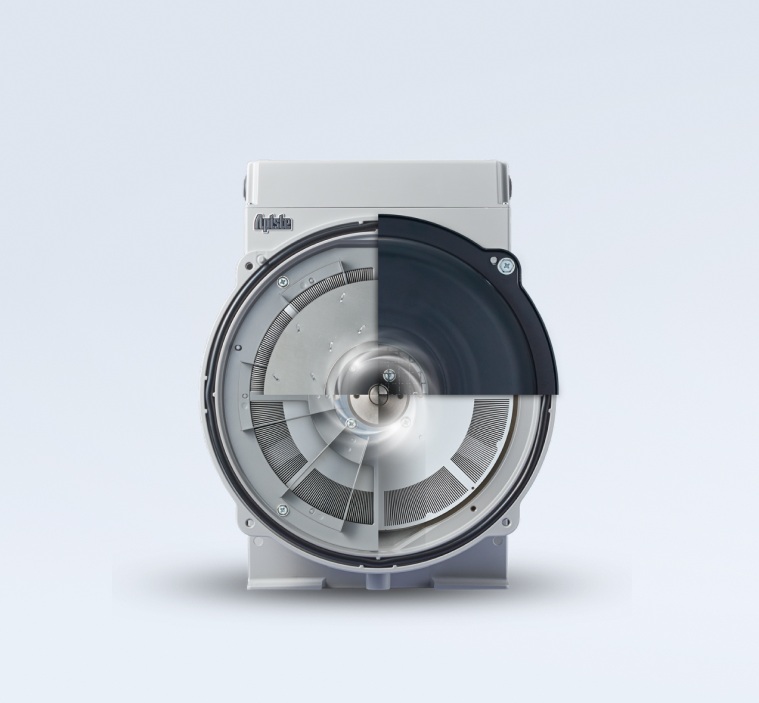
High Performance Mist Collector [GME-S-Pro Series]

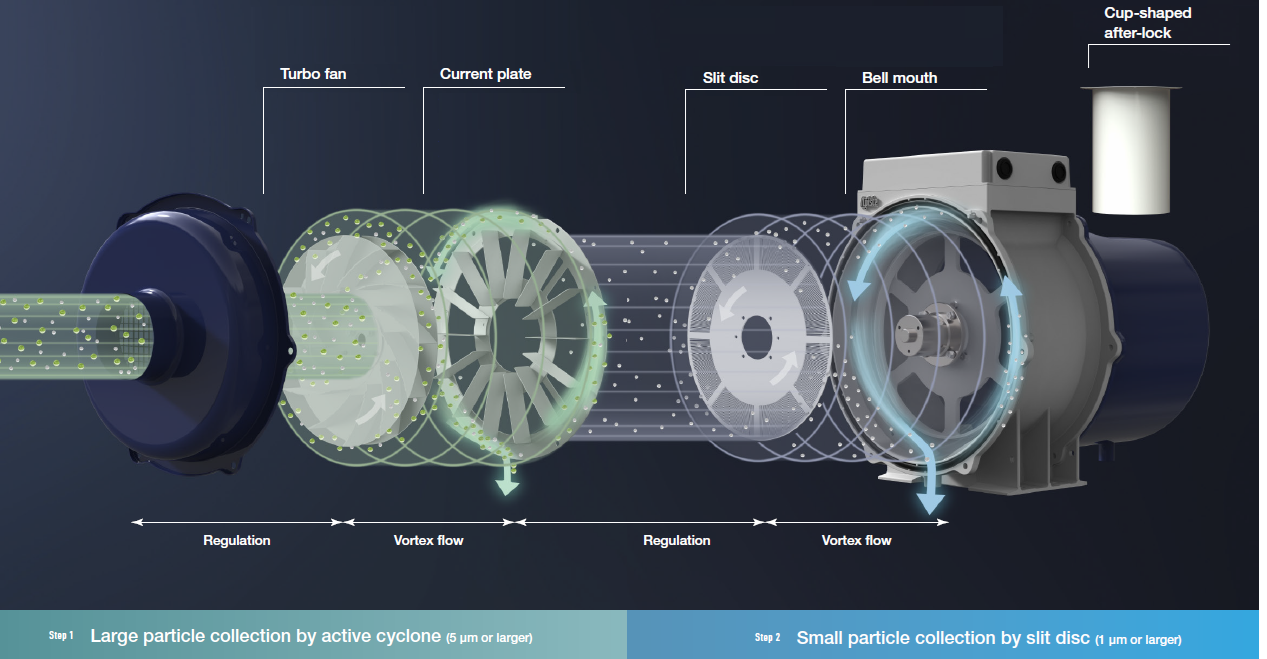
- Multi-stage mist collection helps prevent clogging by using components matched to each droplet size.
Stage 1: Collects oil mist droplets 5 μm and larger with 99.9% efficiency.
An active cyclone system with a turbo fan mounted at the foremost position is used to separate large droplets using strong positive airflow.
Stage 2: Collects oil mist droplets 1 μm and larger.
Fine oil mist that passes through the airflow guide plate is directed along a circular path by a slit disc. The oil mist separated by the slit disc coalesces into liquid droplets at the cone outlet before being discharged through the drain pipe.
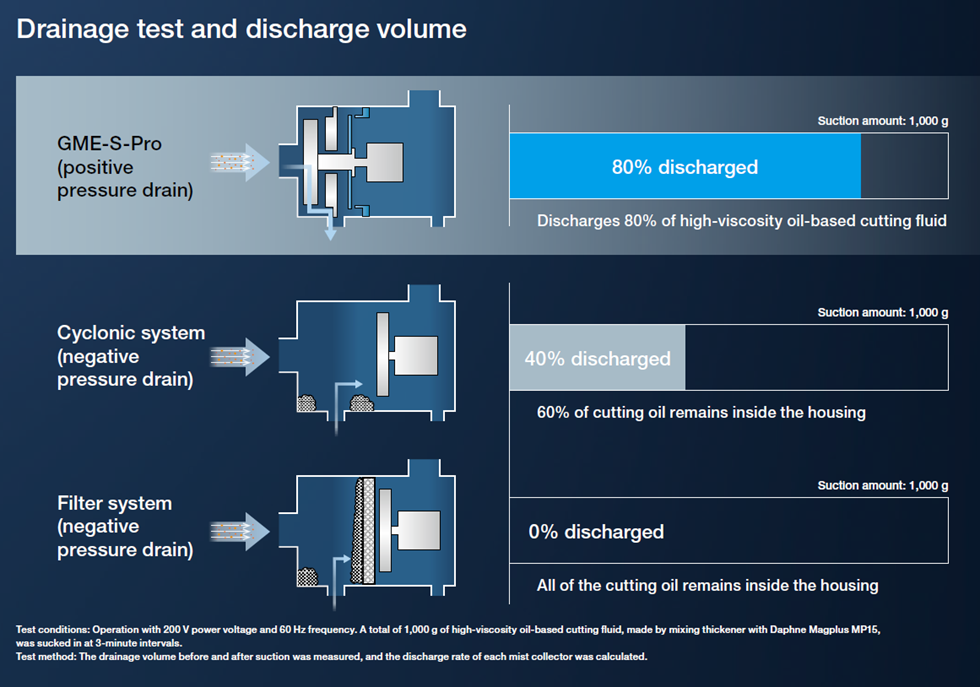
- The positive-pressure drain pipe helps prevent the buildup of contaminants inside the unit.
The turbo fan is installed at the foremost position to create an active cyclone with positive airflow. Mist droplets are reliably discharged through a drain pipe positioned along the flow direction of the active cyclone.
This design not only reduces droplet adhesion and the accumulation of foreign matter inside the equipment—problems commonly found in conventional filter and cyclone systems—but also eliminates the need for liquid seals, which have traditionally caused operational and maintenance issues.
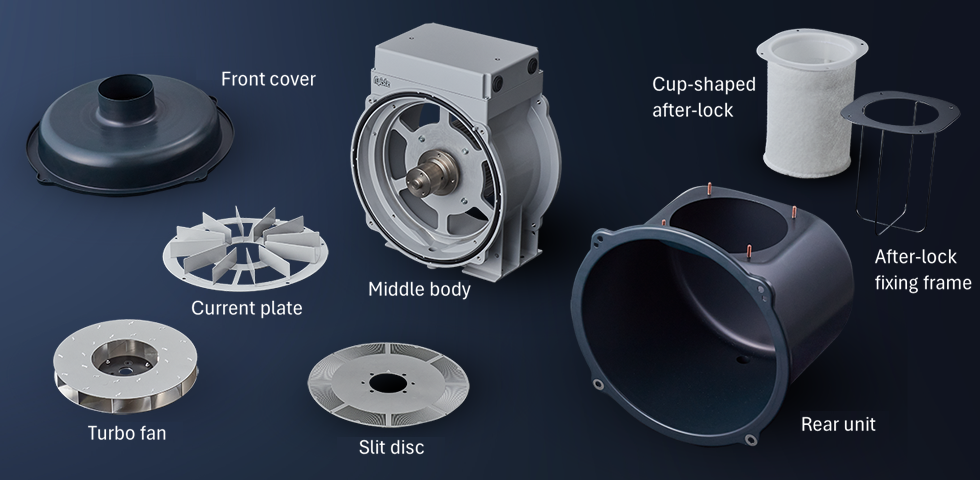
- Easy maintenance with a modular, detachable design.
Normally, mist collectors are designed as non-disassemblable units, making thorough maintenance and cleaning difficult and often frustrating.
In contrast, the GME model is designed so the housing can be easily separated into front, middle, and rear sections, and the multiple internal mist-collection components can also be removed with ease.
This professional-grade series offers high maintenance convenience, enabling long-term operation while maintaining performance comparable to when it was first installed.
Greater energy efficiency—even with high airflow, power consumption remains low.
This is achieved by using a high-efficiency PM motor as standard*, along with a housing designed to allow smooth airflow, reducing losses in areas not involved in mist collection.
In addition, all models—including the 400-watt model—are equipped with an inverter that adjusts airflow according to demand, resulting in greater energy savings compared with conventional ON/OFF mist collector systems.
*The 400-watt model uses an induction motor.
- Energy-saving design
even with minimal power consumption, it can generate a large volume of airflow. The unit is designed to allow smooth air passage, reducing energy loss from parts that do not efficiently capture fine mist droplets.
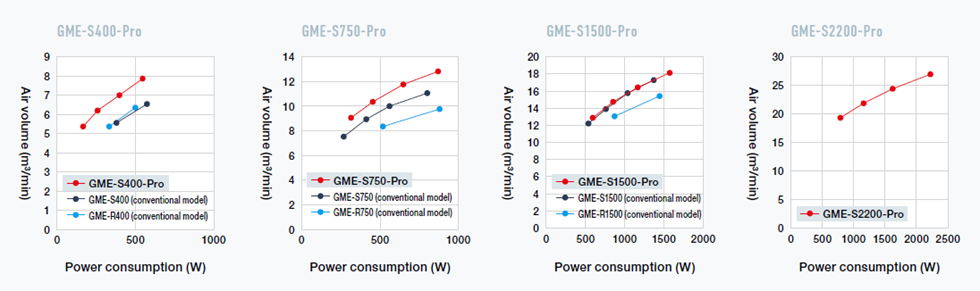
- Energy-efficient through inverter control
allowing the motor speed to be adjusted as needed to 70%, 80%, 90%, or 100% in order to reduce energy consumption.

High-Efficiency Mist Collector
GME-S400-Pro
- Installed motor power: 0.4 kW, 2P (fully enclosed fan type)
- Maximum airflow: 7.7 m³/min
- Mist collection efficiency: 99.7%
- External dimensions (H × W × D): 444 × 368 × 530 mm
- Weight: Approximately 25 kg
GME-S750-Pro
- Installed motor power: 0.75 kW, 4P (fully enclosed fan type)
- Maximum airflow: 12.6 m³/min
- Mist collection efficiency: 99.7%
- External dimensions (H × W × D): 484 × 408 × 539 mm
- Weight: Approximately 26 kg
GME-S1500-Pro
- Installed motor power: 1.5 kW, 4P (fully enclosed fan type)
- Maximum airflow: 18.4 m³/min
- Mist collection efficiency: 99.7%
- External dimensions (H × W × D): 544 × 468 × 574 mm
- Weight: Approximately 33 kg
GME-S2200-Pro
- Installed motor power: 2.2 kW, 4P (fully enclosed fan type)
- Maximum airflow: 27.1 m³/min
- Mist collection efficiency: 99.7%
- External dimensions (H × W × D): 544 × 468 × 674 mm
- Weight: Approximately 37 kg
Application


