


Catalogues


Apiste HFC alternative pump/tankless chiller
HFC Alternative Pump Tankless Chiller
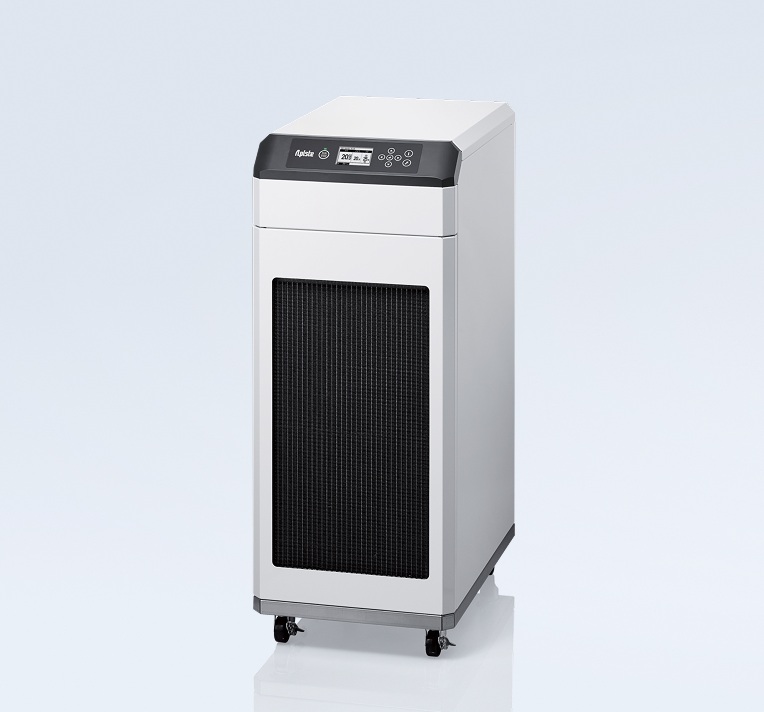
HFC Alternative Pump Tankless Chiller

Pump- and Tankless Structure to Meet Diverse Production Needs
Unlike conventional chillers that have built-in pumps and tanks, the PCU-F Series features a pump- and tankless design in the main unit. This provides significant flexibility in system design, allowing the creation of the most suitable cooling system. It can adapt efficiently and flexibly to a wide range of needs, whether installing new machinery or upgrading existing equipment.
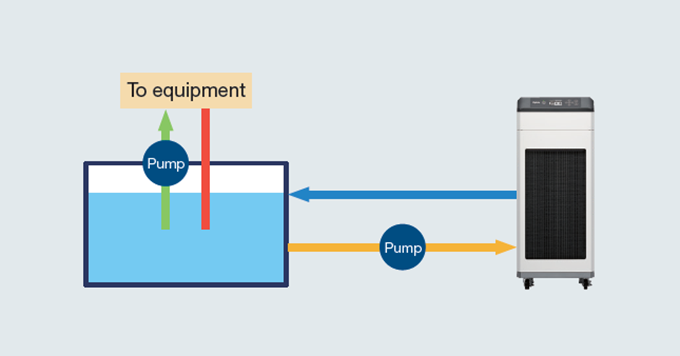
- Open-Circuit Cooling
Open-circuit cooling refers to a method in which the chilled water comes into contact with the external environment. When using a chiller with a built-in pump and tank in an open-circuit system, the load side must be sealed or cooled indirectly through a heat exchanger.
The PCU-F Series, however, features a pump- and tankless design, allowing it to be used in an open circuit without any additional measures. This simplifies system design and greatly increases operational flexibility.
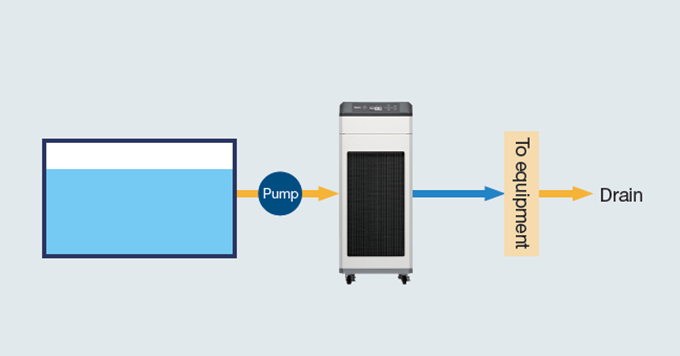
- One-Pass Circuit Cooling
A one-pass circuit is a cooling method in which chilled water is used once and then discharged, commonly applied with tap water or well water. Since this is a type of open circuit where the cooling water comes into contact with the outside air, using a chiller with a built-in pump and tank requires the load side to be sealed or cooled indirectly through a heat exchanger.
However, with the pump- and tankless design of the PCU-F Series, direct cooling is possible even in a one-pass circuit, and it can operate without any additional measures.
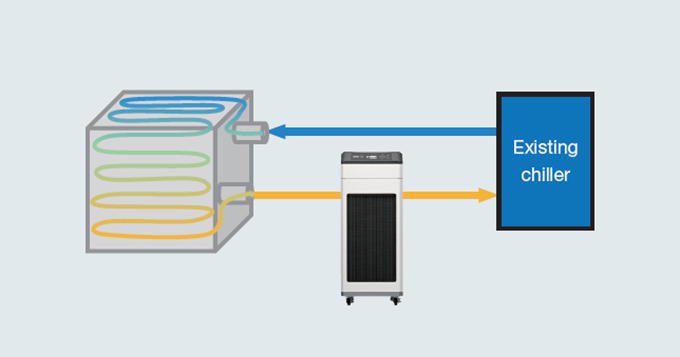
- Supplementing Cooling to an Existing Circuit (Increasing Cooling Capacity)
When the cooling capacity of an existing system is insufficient, chillers with built-in pumps and tanks require careful consideration of flow rate adjustments, piping design, and circuit configuration.
However, the PCU-F Series can be directly connected to an existing circuit to increase cooling capacity without any additional modifications. Its pump- and tankless design makes upgrading existing cooling systems easier and allows for more flexible operation.
Temperature Control Using an External Sensor
Typically, a chiller controls the outlet water temperature to maintain the setpoint. However, the PCU-F Series can also control temperature based on readings from an external temperature sensor.
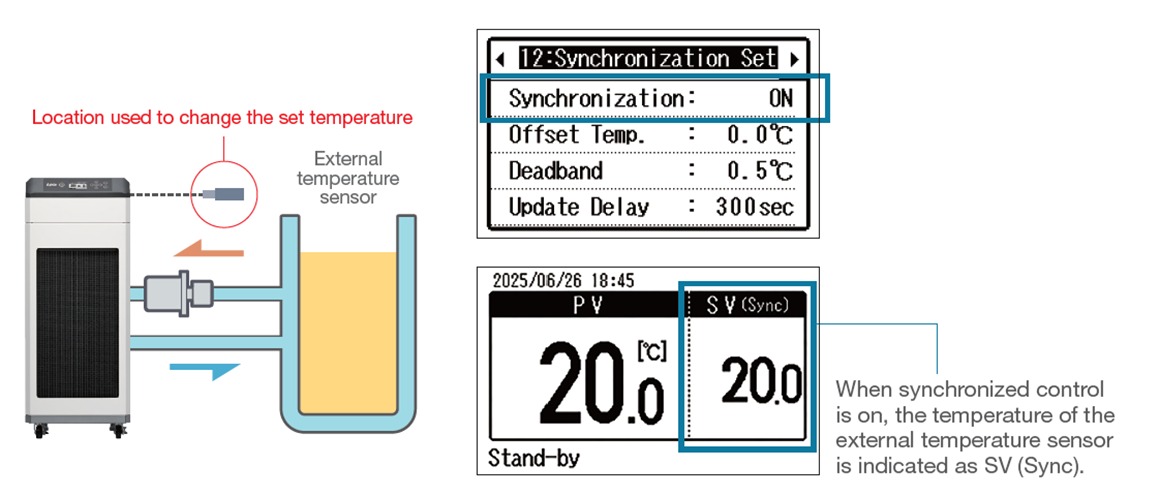
- Synchronized Control
Synchronized control is a method that adjusts the setpoint temperature in accordance with the temperature measured by an external sensor.
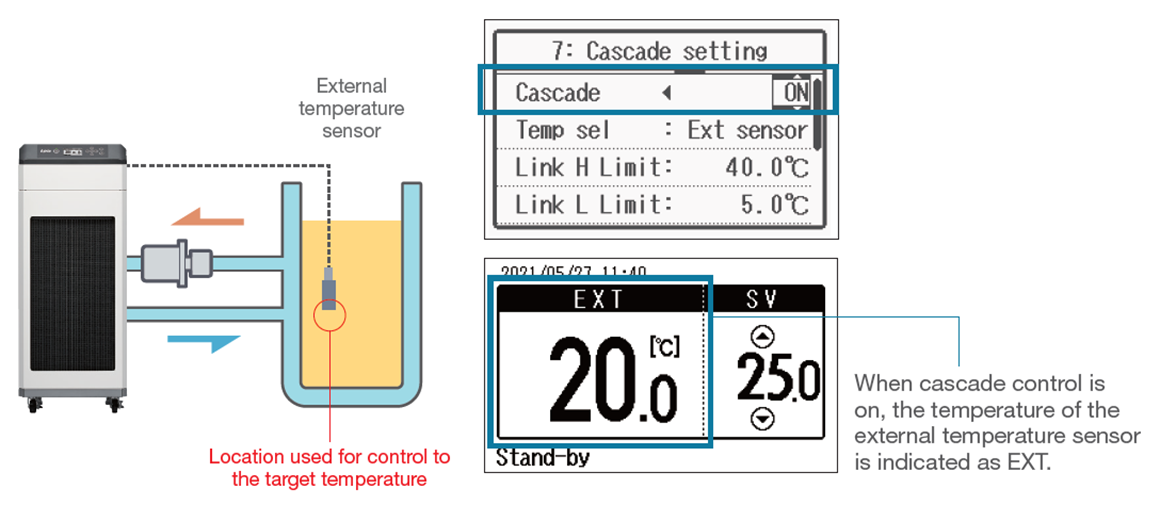
- Cascade Control
Cascade control is a method that adjusts the system so that the temperature at the externally measured point matches the setpoint temperature.
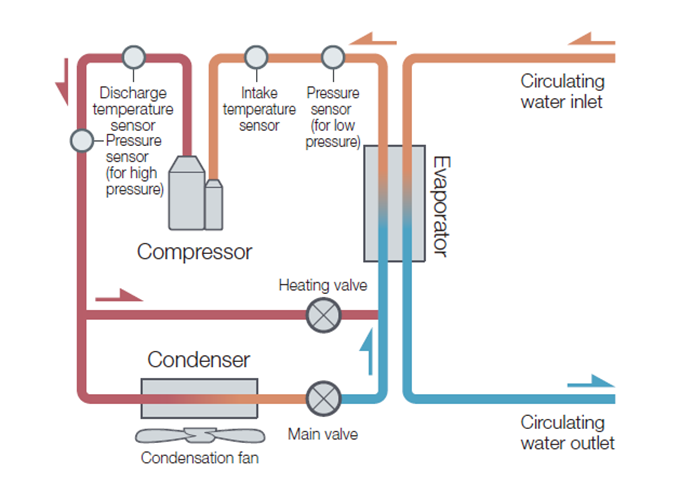
Uses a non-Freon refrigerant, reducing both labor and time required for handling Freon gas.
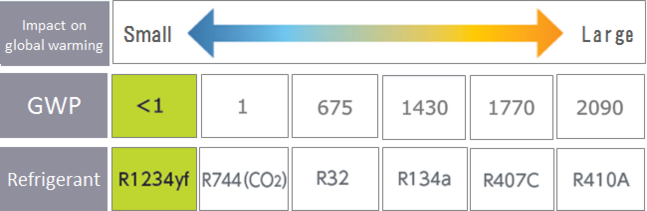
- Uses the Non-Freon Refrigerant R1234yf
In April 2015, Japan enforced the Fluorocarbons Recovery and Destruction Law, which requires operators using equipment that releases fluorocarbons to comply with six obligations, including regular detailed inspections and reporting of leakage amounts. The 2020 amendment strengthened the law by allowing direct fines for operators who violate regulations when disposing of equipment, without going through standard procedures.
The PCU-NE Series uses the non-Freon refrigerant R1234yf, allowing businesses to reduce costs associated with fluorocarbons, as it is not subject to the Fluorocarbons Recovery and Destruction Law. This means there is no need to collect or dispose of the refrigerant or perform periodic inspections.
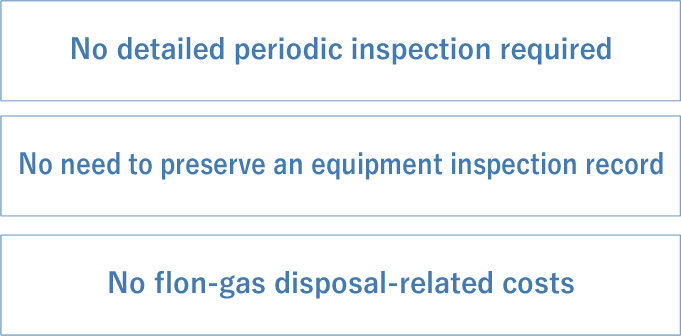
The chiller provides everything you need for 24-hour operation monitoring.
The First Leader in the Industry – PCU-NE Series Chiller with Drive Recorder
The chiller is equipped with a drive recorder that can log:
- Circulating water outlet temperature
- Setpoint temperature of circulating water
- Cumulative operating time
- Date and time of errors
- Other critical operating data
Data can be recorded every 2 minutes for up to 1.5 years.
In the event of an error, the chiller records data every 5 seconds starting approximately 1 minute before the error occurs, allowing for detailed operational analysis.All recorded data can be exported to a computer via a USB memory device.
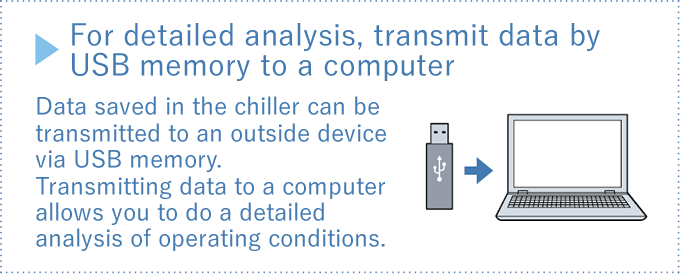
- Calendar Function
The chiller is equipped with a calendar function. Data recorded by the drive recorder, such as daily circulating water temperatures, error history, and other operational information, can be checked at any time using the calendar.
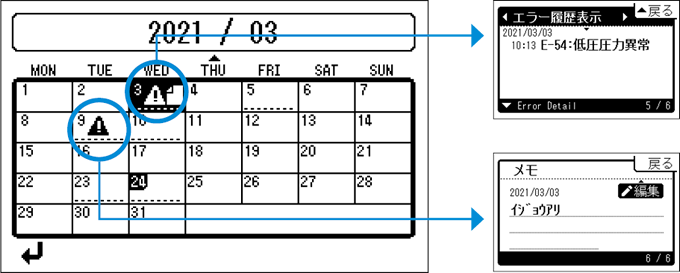
- Measure and Record External Temperature
You can use an external temperature sensor to measure the temperature of an external object and record the data in the chiller. With a single setup, it is possible to log both the chiller’s operating data and the external temperature data.

New Basic Functions – Easy and Safe to Use
- IoT Support with Modbus TCP
To meet the growing demands of IoT-enabled factories, this chiller supports Ethernet connectivity. In addition to reading and writing data via Modbus/TCP, the chiller also supports MC protocol and Socket communication.
The chiller offers sufficient flexibility to meet all IoT-era requirements, whether for monitoring operational performance, displaying data, or enabling remote control.
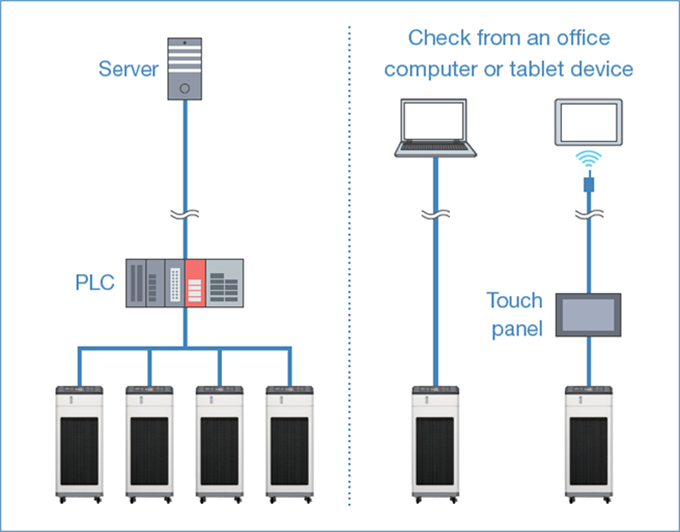
Pumpless/Tankless Air-Cooled Chiller – HFC Alternative
PCU-F3000 (HFC Replacement / Compact Size)
- Cooling Capacity (W): 2800 / 3200
- Circulating Water Flow Range (L/min): 10–60
- Standard Circulating Water Flow (L/min): 15
- Temperature Control Accuracy (°C): ±0.1
- External Dimensions (H × W × D) (mm): 697 × 400 × 600
PCU-F7000 (HFC Replacement / Compact Size)
- Cooling Capacity (W): 5700 / 6700
- Circulating Water Flow Range (L/min): 10–60
- Standard Circulating Water Flow (L/min): 30
- Temperature Control Accuracy (°C): ±0.1
- External Dimensions (H × W × D) (mm): 997 × 400 × 600
Application


