


Catalogues


Apiste HFC Alternative Chiller
HFC Alternative Chiller
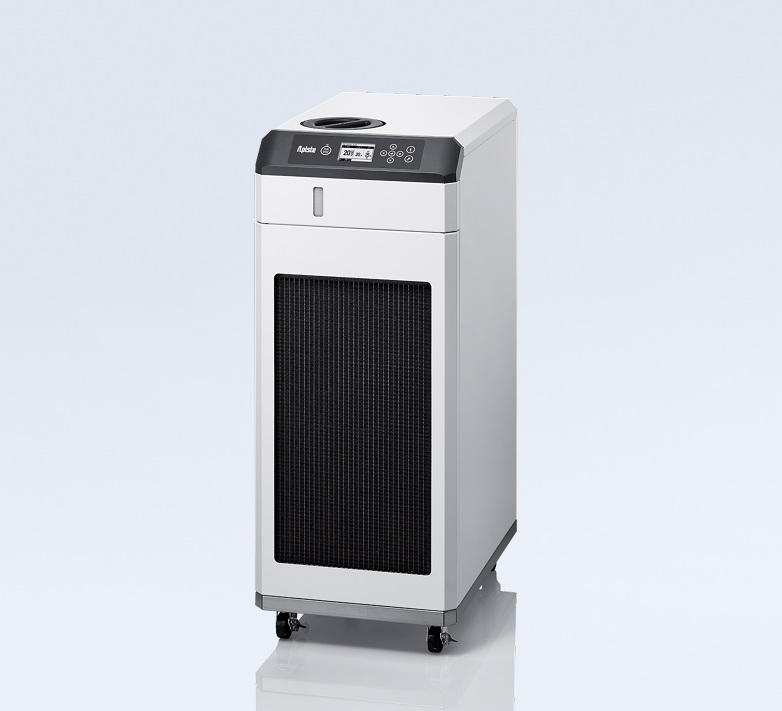
HFC Alternative Chiller

Uses a non-Freon refrigerant, reducing both labor costs and the time required for handling Freon gases.
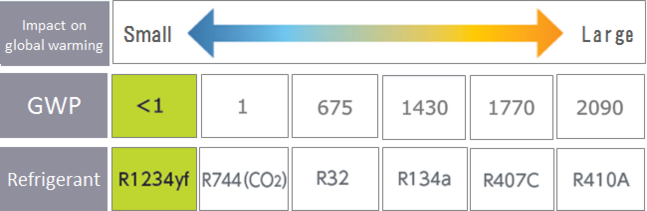
- Uses R1234yf refrigerant, which is a non-Freon gas.
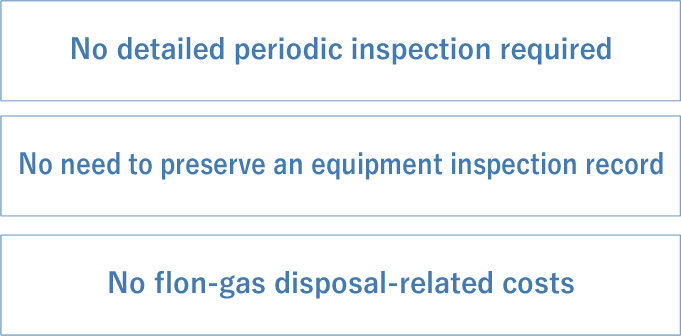
In April 2015, Japan enacted the Fluorocarbon Recovery and Destruction Act, which requires businesses using equipment that emits fluorocarbons to comply with six obligations, including regular detailed inspections and reporting of leakage volumes. The law was revised in 2020 to further strengthen enforcement, introducing direct financial penalties for operators who dispose of equipment in violation of the law without following the required management procedures.
The PCU-NE series uses R1234yf refrigerant, which is a non-Freon gas. As a result, businesses can significantly reduce costs related to fluorocarbons. Since it is exempt from the Fluorocarbon Recovery and Destruction Act, there is no need to recover or dispose of the refrigerant, nor is periodic inspection required.
Cooling units provide everything you need to monitor operation 24 hours a day.
- The first leader in this industrial market: the PCU-NE series with a data logger.
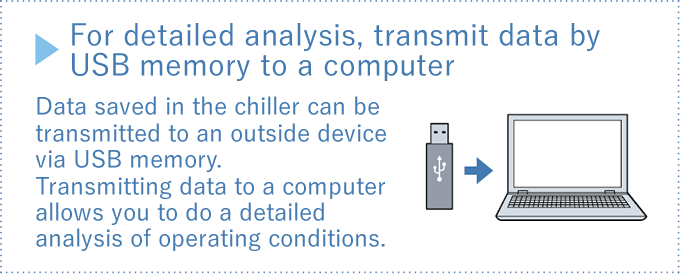
The chiller’s operation can record data such as circulating water outlet temperature, circulating water set temperature, cumulative operating time, the date and time of errors, and other key operational information.The chiller can record data every 2 minutes for up to approximately one and a half years*.When an error occurs, the chiller records data every 5 seconds starting from about 1 minute before the error, enabling detailed analysis of operating conditions.The data recorded in the chiller can be transferred to a computer via USB.
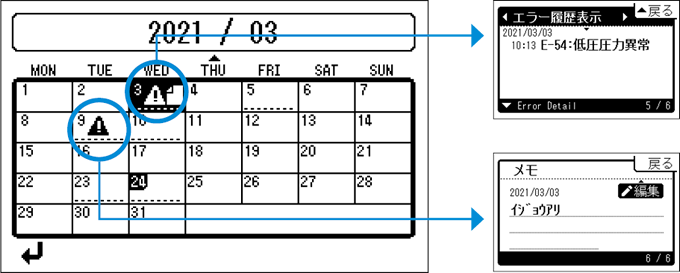
- Calendar function
The chiller is equipped with a calendar function. Information such as daily circulating water temperature, error history, and other data recorded by the operation logger can be checked at any time using the calendar.
- Measure and record external temperature
An external temperature sensor can be used to measure the temperature of external objects and record the data in the chiller. Both chiller operating data and external temperature data can be recorded using a single device.

New basic functions for easy and safe operation.
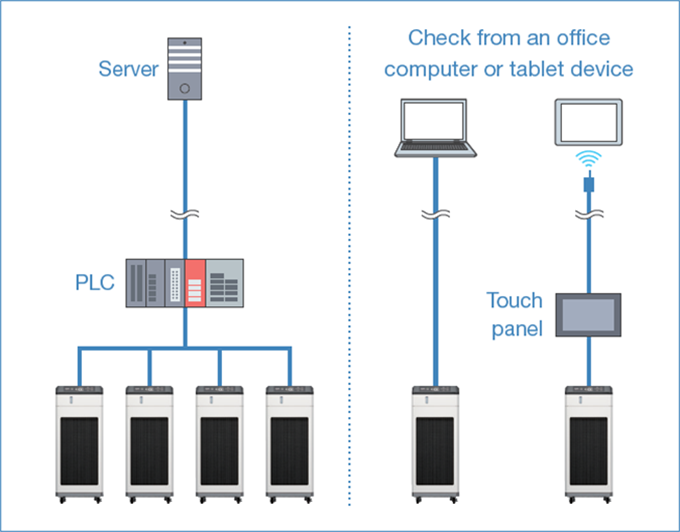
- Supports IoT via Modbus TCP
To meet the growing demand for IoT-enabled production areas, the chiller supports Ethernet connectivity. In addition to reading and writing data through external communication via Modbus/TCP, the chiller also supports the MC protocol and Socket communication. The chiller is flexible enough to meet all IoT-era requirements, including performance monitoring, visual data display, and remote control.
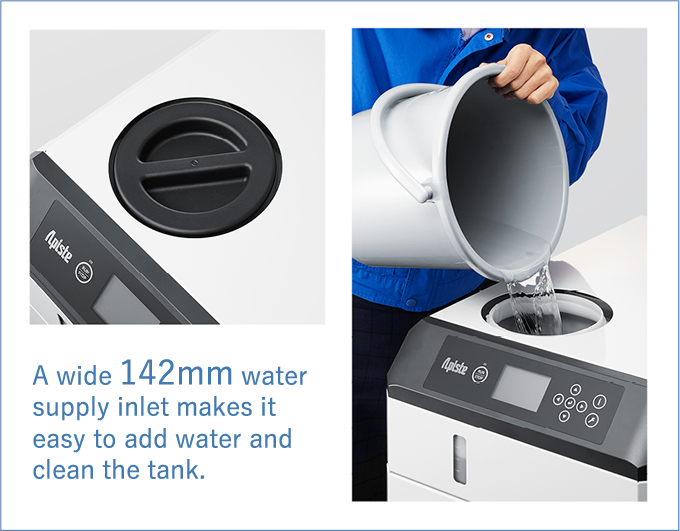
- Wide-mouth water tank for easy refilling
The water tank features a wide 142 mm fill opening, making it easy to add water to the chiller. In addition to convenient refilling, the wide opening allows easy access for hand cleaning inside the tank. It also makes it simple to check the water quality, as the wide opening provides a clear view inside the tank.
- Top-class four-blade multi-stage centrifugal pump
The four-blade multi-stage centrifugal pump delivers circulating water smoothly without vibration. The mechanical seal is made of highly wear-resistant silicon carbide (SiC), which lasts about twice as long as conventional carbon seals (maintenance interval: 15,000 hours), so there is almost no concern about water leakage due to mechanical seal deterioration.

- Reliable cooling performance
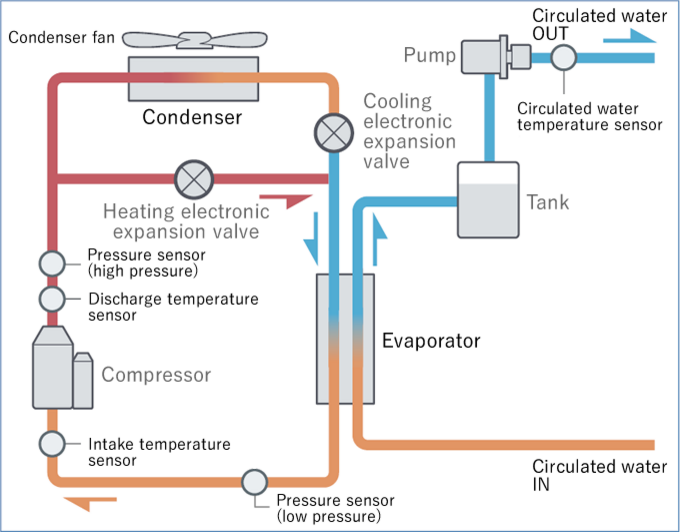
Two electronic expansion valves work together with internal temperature sensors to provide highly precise temperature control, maintaining stability within ±0.1°C and keeping the circulating water temperature in the range of 5 to 40°C. The chiller can operate excellently in environments that require high temperature accuracy. Additionally, it can function in ambient temperatures from 5 to 45°C, allowing continuous operation even in high-temperature or varying environmental conditions.
- Temperature control with external temperature sensor
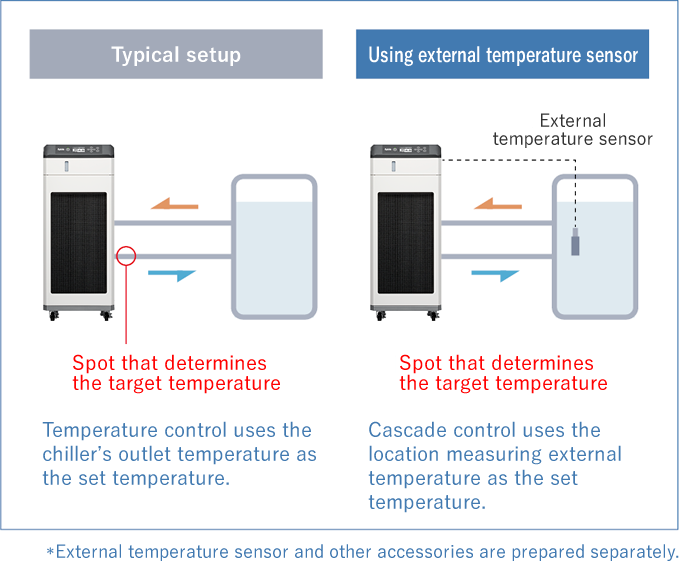
Typically, a chiller controls the temperature based on the set value at the circulating water outlet. However, the PCU series chillers come with an external temperature sensor that enables “Cascade Control,” using the temperature of the external object as a reference for setting the target temperature. For example, when controlling the temperature of material in a Jacket Tank, the chiller adjusts the temperature according to the actual working environment. *The external temperature sensor and other accessories must be provided separately.
- Space-saving and compact
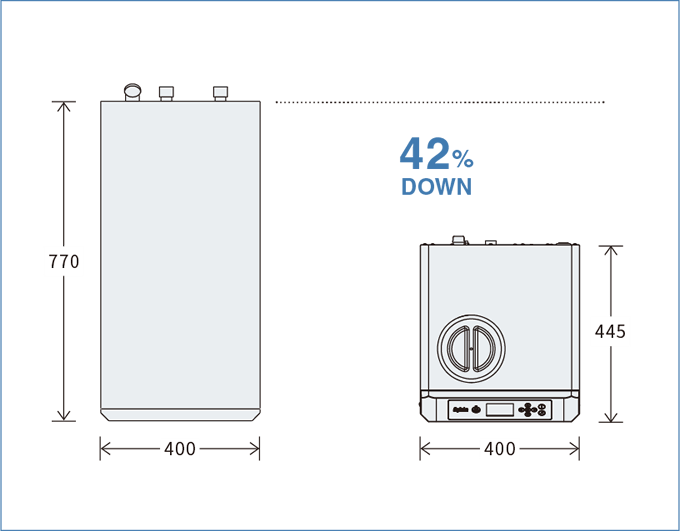
The installation footprint is reduced by up to 42% compared to the current model, allowing for much more efficient use of space. The chiller is designed with the evaporator, water tank, and pump directly connected, featuring a pipe-free structure*, which minimizes the need for piping and results in a compact unit. By combining stable performance with a space-efficient design, this model effectively enhances production efficiency. *PCU-NE1500 only.
Alternative Chillers – HFC-free Refrigerant
Air-cooled Chiller, PCU-NE1500 (HFC-free alternative | Compact size)
- Cooling capacity (W): 1300 / 1400
- Heating capacity (W): 230 / 350
- Temperature control accuracy (°C): ±0.1
- External dimensions (H × W × D) (mm): 610 × 400 × 445
Air-cooled Chiller, PCU-NE2500 (HFC-free alternative | Compact size)
- Cooling capacity (W): 2300 / 2600
- Heating capacity (W): 400 / 600
- Temperature control accuracy (°C): ±0.1
- External dimensions (H × W × D) (mm): 697 × 400 × 600
Air-cooled Chiller, PCU-NE6000 (HFC-free alternative | Compact size)
- Cooling capacity (W): 5400 / 6000
- Heating capacity (W): 1200 / 1600
- Temperature control accuracy (°C): ±0.1
- External dimensions (H × W × D) (mm): 997 × 400 × 600
Water-cooled Chiller, PCU-NE2500W (HFC-free alternative | Compact size)
- Cooling capacity (W): 2600 / 3100
- Heating capacity (W): 280 / 450
- Temperature control accuracy (°C): ±0.1
- External dimensions (H × W × D) (mm): 697 × 400 × 600
Water-cooled Chiller, PCU-NE6000W (HFC-free alternative | Compact size)
- Cooling capacity (W): 5400 / 6000
- Heating capacity (W): 1400 / 1900
- Temperature control accuracy (°C): ±0.1
- External dimensions (H × W × D) (mm): 997 × 400 × 600
Application


